
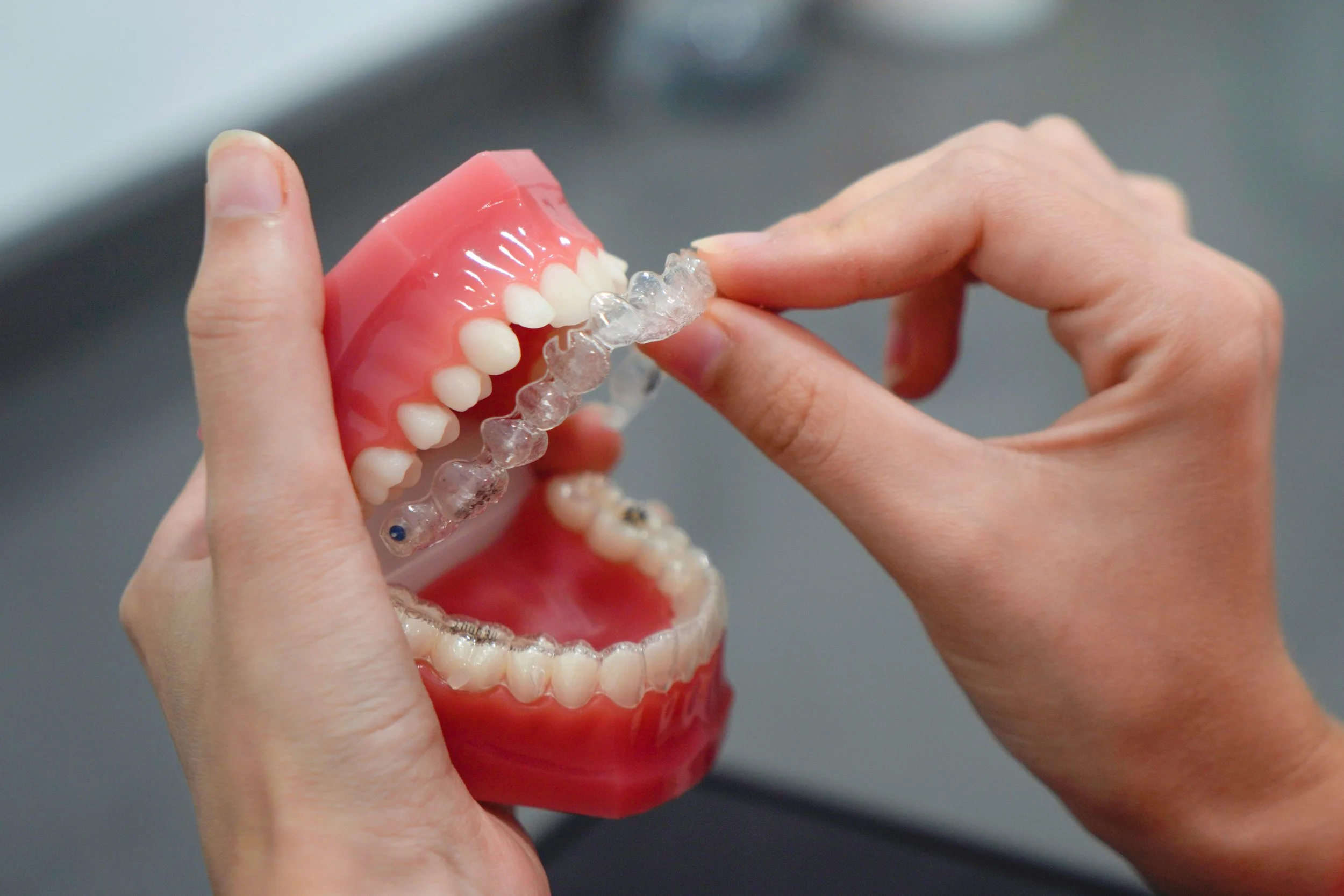
Invisalign vs Braces: Which Is Right for You?
We fit both, so we have no reason to sell you one. Here is the framework Dr. Beth actually uses to decide — and the four questions that settle it for most people.

Braces can treat more. Aligners are nicer to live with.
That is genuinely the whole trade-off, and everything below is detail on it.
Both move teeth by the same biological process — sustained pressure, bone remodelling around the root. Neither is more “advanced” than the other. Aligners are newer, which is not the same thing as better.
For mild to moderate crowding and spacing, outcomes are comparable and the decision is about lifestyle. For complex rotations, large vertical movement, extraction cases and significant bite correction, fixed braces do the job more predictably and often faster — and no amount of preferring aligners changes that.
The uncomfortable part is that the deciding factor is frequently not clinical at all. It is whether you will genuinely wear a removable appliance twenty to twenty-two hours a day, every day, for a year or more.
Four questions, in order of weight
Work through these honestly and you will usually arrive at the same answer Dr. Beth does.
Is your case within the aligner range?
This one is not up for discussion — it is anatomy. Mild to moderate crowding, spacing and bite issues are well within range. Severe rotations on round-rooted teeth, moving a tooth bodily across an extraction space, significant vertical movement and guiding an impacted canine are not. A 3D scan settles it in ten minutes. If your case is outside the range, the remaining questions are moot.
Will you actually wear them?
Twenty to twenty-two hours a day. Out for every meal and every drink that is not water, then straight back in. Not left in a napkin at lunch, not skipped on holiday. If you have any doubt, take the braces — they work whether or not you remember. Cases that stall because of wear time end up longer and more expensive than braces would have been.
How much does visibility matter, in real terms?
Be specific rather than general. “I would prefer not to have metal” points to ceramic braces at a lower cost. “I present to clients four days a week for the next eighteen months” points to aligners or lingual. The stronger the requirement, the more it should outweigh the other factors.
What does your life actually look like?
Contact sport favours aligners — take them out, wear a normal mouthguard. Wind and brass instruments often favour braces, since aligners interfere with embouchure. Heavy travel favours aligners, with sequences issued in batches. A teenager who loses things twice a week favours braces.
The full comparison
| Invisalign | Braces | |
|---|---|---|
| Typical duration | 6–18 months | 18–24 months |
| Office visits | Every 6–8 weeks | Every 4–6 weeks |
| Visibility | Nearly invisible | Visible; ceramic blends, lingual hidden |
| Removable | Yes | No |
| Food restrictions | None | Hard, sticky, chewy foods |
| Brushing & flossing | Normal — take them out | Interdental brushes, floss threader |
| Depends on you | Entirely — 20–22 hrs daily | Not at all |
| Complex cases | Limited | Full range |
| Emergencies | Rare — lost or cracked tray | Loose brackets, poking wires |
| Contact sport | Remove, standard mouthguard | Orthodontic mouthguard over brackets |
| Wind instruments | Can interfere | 1–2 week adjustment, then fine |
| Relative cost | Comparable to ceramic braces | Metal lowest; ceramic mid; lingual highest |
Which costs more?
Usually less than people expect, in either direction. Metal braces are typically the most economical option. Invisalign sits roughly alongside ceramic braces, because each set of aligners carries a laboratory fee and longer cases need more of them. Lingual braces are the most expensive, being custom-made per tooth.
However, aligner cases often run shorter, which offsets part of the difference. A ten-month aligner case and a twenty-two-month braces case are not the same amount of clinical time, and fees track treatment length more than they track appliance type.
The comparison that actually matters is between two quotes for your case, which is why we price both at the consultation. Insurance treats them identically — orthodontic benefits do not distinguish between appliances — and our 0% APR monthly plans apply either way.
Five things people believe that are not true
“Invisalign is always faster”
Aligner cases often finish sooner, but that reflects which cases are selected for aligners in the first place — simpler ones. Compare like for like and the difference narrows considerably. A complex case treated with aligners can take longer than with braces, if it can be treated at all.
“Braces are old technology”
Brackets, wires and the mechanics behind them have advanced continuously. Modern brackets are smaller, wires apply gentler and more consistent force, and treatment is planned digitally. Fixed appliances remain the most capable tool orthodontics has.
“Invisalign is more comfortable”
Broadly true — no brackets rubbing your cheeks. But each new tray brings its own pressure, and you get that every one to two weeks rather than every four to six. Total discomfort across treatment is not as different as expected.
“You can switch halfway if it is not working”
You can, but it usually costs time and money. A stalled aligner case often needs re-scanning and re-planning before braces are placed. Choosing correctly at the start is considerably cheaper than correcting course at month ten.
“Mail-order aligners are the same thing”
They are not. No orthodontist examines you, nobody scans your roots and bone, nobody checks gum health before starting, and nobody adjusts the plan when a tooth does not track. That is why they accept cases they should decline.
“Adults should not get braces”
Roughly one in four orthodontic patients is an adult. If your case needs braces, ceramic or lingual options keep treatment discreet. Choosing aligners for a case that needs braces is not discretion, it is a worse result.
Invisalign vs braces FAQ
Is Invisalign as effective as braces?
For mild to moderate crowding, spacing and bite issues, outcomes are comparable. Outside that range — severe rotations, large vertical movement, closing extraction spaces, impacted teeth — fixed braces are more predictable and often faster. A 3D scan at your consultation determines which category your case falls into.
Which is cheaper, Invisalign or braces?
Metal braces are typically the most economical. Invisalign sits roughly alongside ceramic braces since each aligner set carries a lab fee. Lingual braces are the most expensive. However, fees track treatment length more than appliance type, and shorter aligner cases can close the gap. We quote both for your case at the free consultation.
Which is faster?
Aligner cases average six to eighteen months and braces eighteen to twenty-four, but that partly reflects aligners being used on simpler cases. Compared like for like the difference is smaller. Wear time matters more than appliance choice — a case where aligners are worn sixteen hours a day will finish slower than braces would have.
Can I switch from Invisalign to braces mid-treatment?
Yes, and it happens when a case is not tracking as planned. It usually means re-scanning and re-planning, which costs time and sometimes money. Choosing correctly at the outset is considerably cheaper than changing course at month ten.
Which is better for teenagers?
It depends entirely on compliance. Invisalign Teen includes wear indicators that fade so parents can check, plus free replacements. If you already suspect twenty hours a day will not happen, fixed braces are the more reliable choice and we will say so.
Does insurance cover one more than the other?
No. Orthodontic benefits apply to the treatment rather than the appliance, so your coverage is the same either way. We verify your benefit before treatment starts regardless of which you choose.
Which hurts less?
Aligners avoid brackets rubbing against the cheeks, which is the main source of soft-tissue irritation with braces. However, each new tray brings fresh pressure every one to two weeks, versus every four to six with braces. Neither is painful in any serious sense.
How do I find out which one I need?
Book a free consultation. Dr. Beth takes a 3D iCAT scan, reviews it with you on screen, and tells you which options genuinely suit your bite — including when the answer is not the one you were hoping for. You leave with both quoted where both are viable.
Stop guessing. A scan answers it in an hour.
Free consultation, 3D imaging, and both options priced where both are viable — plus Dr. Beth’s honest read on which fits your bite and your life.