
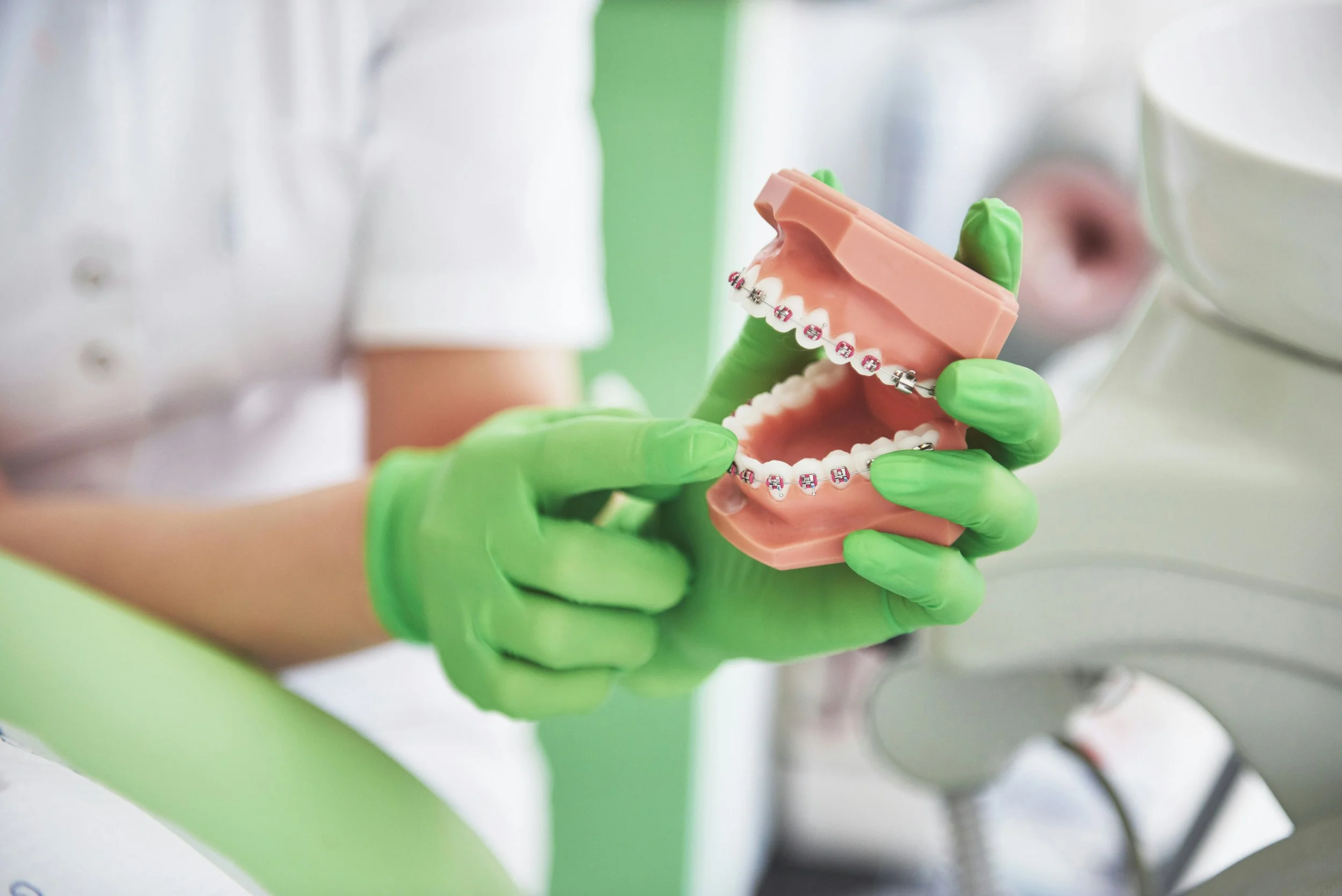
Impacted Teeth Treatment in Las Vegas & Henderson
A permanent tooth that has not arrived on schedule is one of the few orthodontic situations where delay genuinely costs you options.
What an impacted tooth is
An impacted tooth is a permanent tooth that has failed to erupt into its proper position and is stuck — either blocked by another tooth, by bone, or growing in the wrong direction entirely.
Wisdom teeth are the most commonly impacted, and those are usually a matter for an oral surgeon. In orthodontics the tooth that matters most is the upper canine, the second most frequently impacted tooth and one you cannot simply remove — canines carry a substantial share of chewing load and shape the corner of the smile.
Canines erupt late, typically around ages eleven to thirteen, and they travel a long path through bone to get there. That journey is what makes them prone to getting lost along the way.
Why teeth become impacted
Not enough room in the arch
Severe crowding leaves no space for a late-erupting tooth, so it stays put or diverts. This is the most common reason and the one early treatment can prevent.
Baby teeth that will not come out
A retained baby canine blocks the permanent one beneath. Removing it at the right moment sometimes allows the permanent tooth to find its own way in.
An abnormal eruption path
Some canines simply set off in the wrong direction, ending up positioned across the roof of the mouth or high above the arch.
Extra teeth
A supernumerary tooth in the path physically obstructs the permanent tooth behind it. These are usually identified on imaging rather than clinically.
Cysts or dense bone
Less commonly, a cyst or unusually dense bone around the developing tooth prevents it from progressing.
Family history
Impacted canines cluster in families, so if a parent or sibling had one, mention it — it changes how closely we watch.
Why this is time-sensitive
Root resorption of neighbouring teeth
The serious risk. An impacted canine pressing against the root of the adjacent lateral incisor can dissolve that root, sometimes to the point the healthy tooth is lost. It is painless and invisible without imaging.
The tooth can fuse to bone
Left long enough, an impacted tooth can ankylose — fuse directly to the surrounding bone. Once that happens it cannot be moved orthodontically at all.
Options narrow with age
Guiding an impacted canine into place is considerably more predictable in a teenager than in an adult. The same tooth at thirty may not be recoverable.
Cyst formation
An unerupted tooth can develop a fluid-filled cyst around it, which damages surrounding bone and requires surgical management.
The gap affects the whole arch
While the canine is missing, neighbouring teeth drift into its space, complicating treatment later and sometimes closing the room it needs.
How impacted teeth are managed
What is achievable depends heavily on whether growth is still available. This is why the timing of an evaluation matters.
Detection — ages 8 to 11
This is where the 3D iCAT scan earns its place. An impacted canine is invisible clinically and hard to localise on a flat X-ray, but a three-dimensional scan shows exactly where it is, which direction it is heading, and whether it is contacting a neighbouring root. Detected at nine or ten, removing the baby canine at the right moment sometimes lets it correct its own path with no further treatment.
Creating space
Where crowding is blocking the tooth, expansion or braces can open the room it needs. Sometimes this alone is enough for the tooth to erupt on its own once the obstruction is gone.
Exposure and traction
Where the tooth will not come in unaided, an oral surgeon exposes it under local anaesthetic and bonds a small attachment with a fine chain. Dr. Beth then applies gentle traction through your braces, guiding the tooth into the arch over several months. It is slow by design — pull too hard and you damage the tooth and its supporting bone.
Impacted Teeth FAQ
How do I know if a tooth is impacted?
Usually you cannot tell by looking, which is the difficulty. The signs are a permanent tooth that has not arrived by the expected age, a baby tooth that will not fall out, or a visible bulge in the gum. Detection generally comes from imaging at a routine orthodontic evaluation, which is one of the practical reasons for a check by age seven.
Which teeth are most commonly impacted?
Wisdom teeth first, which are usually managed by an oral surgeon. In orthodontics the upper canine matters most — it is the second most frequently impacted tooth, it erupts late, and it cannot simply be removed because it carries significant chewing load and defines the corner of the smile.
What happens if an impacted tooth is left alone?
Several things, none good. It can press against and dissolve the root of a neighbouring tooth, which is painless and invisible without imaging. It can fuse to the bone, after which it cannot be moved at all. It can form a cyst. And neighbouring teeth drift into its space in the meantime.
Does exposing an impacted tooth hurt?
The exposure is a short procedure done under local anaesthetic by an oral surgeon, with soreness for a few days afterwards. The traction phase that follows feels much like normal braces — steady pressure rather than pain. It proceeds slowly by design.
How long does it take to bring an impacted tooth into place?
Several months for the tooth itself, sometimes longer depending on how far it has to travel and its starting angle, and it forms part of an overall treatment that generally runs two years or more.
Can an impacted canine be fixed in an adult?
Sometimes, but success is considerably less predictable than in a teenager, and the tooth may have fused to the bone. Where it cannot be recovered, the alternatives are substituting the adjacent tooth into the canine position orthodontically, or removing it and placing an implant.
Why does a 3D scan matter for impacted teeth?
Because a flat X-ray cannot reliably show where an impacted tooth sits in three dimensions, which direction it is heading, or whether it is already contacting a neighbouring root. The iCAT FLX scan shows all three, and that information determines whether the tooth can be saved and how.
Find out what is actually going on — free.
An hour with Dr. Beth, a 3D scan, and a straight answer about whether treatment is warranted, when, and what it would cost. Including “not yet” where that is the honest answer.