
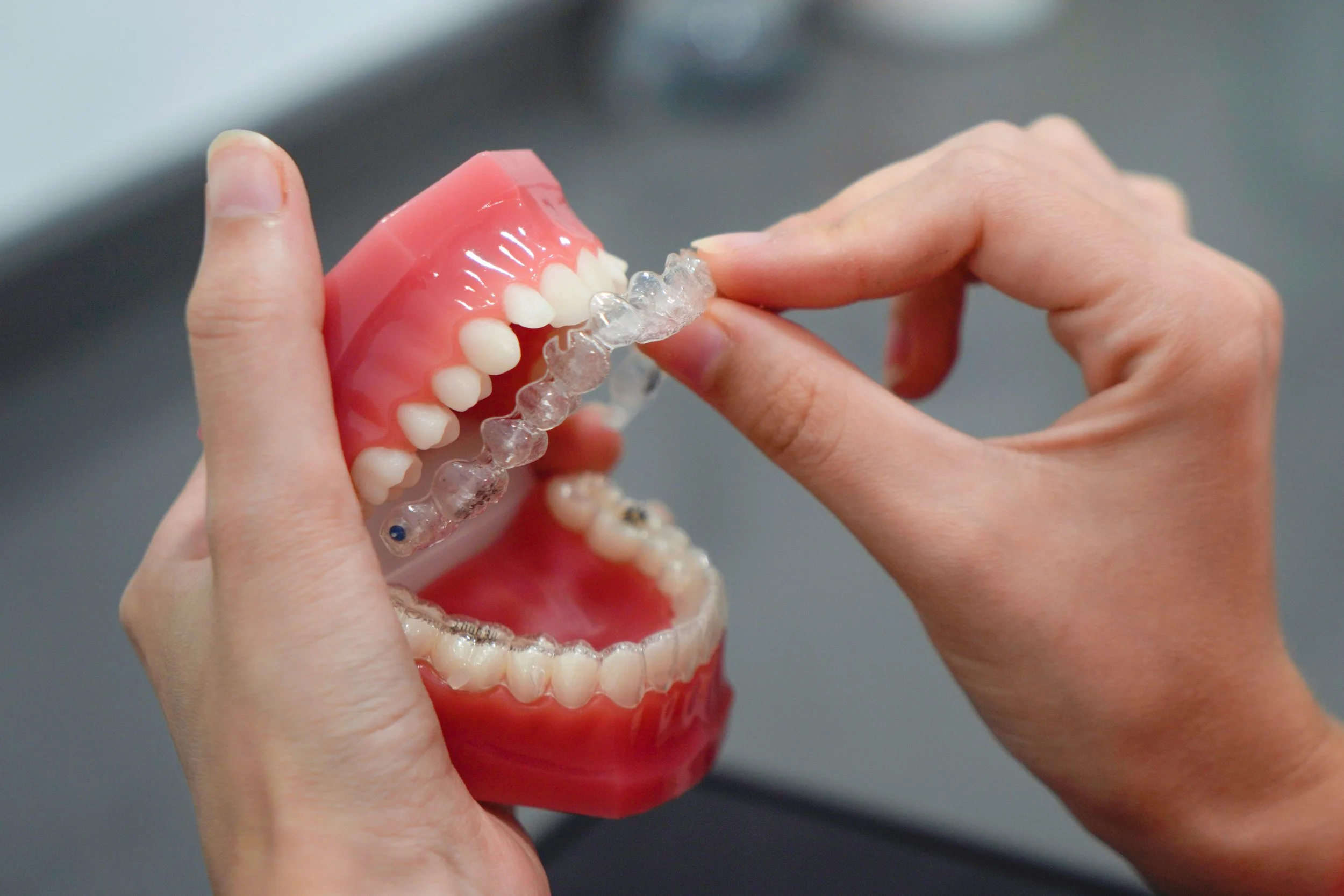
Crowded Teeth Treatment in Las Vegas & Henderson
The most common reason anyone comes to see us — and the one that quietly gets worse if left alone.

What crowding actually is
Crowding is a mismatch between the size of your teeth and the size of the arch they have to fit into. When there is not enough room, teeth overlap, rotate, or get pushed out of the arch entirely.
It ranges from a couple of rotated lower incisors to severe crowding where teeth are displaced well out of line, and canines end up erupting high above the arch because there is nowhere else for them to go.
One thing worth knowing: crowding is progressive. Lower front teeth tend to crowd further with age even in people who never had braces — it is a normal part of ageing. So the crowding you notice at thirty is generally not as bad as it will be at forty-five.
Why teeth crowd
Tooth size versus jaw size
The fundamental cause. Both are inherited, and you can inherit a large tooth size from one parent and a smaller jaw from the other. Nothing you did caused it.
A narrow upper arch
Where the upper jaw is narrower than it should be, there is simply less arch length available. Often treatable in children with expansion.
Early loss of baby teeth
Baby molars hold space for the permanent teeth beneath. Lose one early without a space maintainer and neighbouring teeth drift into the gap.
Baby teeth retained too long
The opposite problem — a baby tooth that will not come out can force the permanent tooth to erupt out of position.
Late lower jaw growth
The lower jaw continues developing into the late teens, and late mandibular growth is a recognised contributor to lower incisor crowding.
Wisdom teeth
Their role is debated among orthodontists and probably smaller than commonly claimed. Late crowding happens with or without them, though we will assess yours.
Why crowding is worth correcting
Cleaning becomes genuinely harder
Overlapping teeth create surfaces a brush cannot reach and floss struggles to enter. That translates to more plaque, more decay between teeth and more gum inflammation over decades.
Gum disease risk rises
Plaque left undisturbed in inaccessible spots is the direct mechanism behind gum disease, and crowded areas are exactly where it accumulates.
Uneven wear
Teeth out of alignment meet at angles they were not built for, wearing specific spots faster than the rest.
It gets worse, not better
Lower incisor crowding progresses through adult life. Treating at thirty is a smaller job than treating at fifty.
Teeth can be pushed out of the bone
Severe crowding can displace a tooth outside the bone that supports it, contributing to recession around it.
How crowding is treated
What is achievable depends heavily on whether growth is still available. This is why the timing of an evaluation matters.
In children
Where crowding is clearly developing and the jaw is still growing, expansion can create arch width and often reduces or removes the need for extractions later. Space maintainers preserve room where a baby tooth has been lost early. Frequently the right answer is to monitor and treat once the permanent teeth are in.
In teenagers
The standard window for comprehensive treatment. Braces or aligners align the arch, sometimes combined with interproximal reduction — polishing a fraction of a millimetre from between teeth to create room. Extractions are considered for severe crowding, and only where genuinely required.
In adults
Mild to moderate crowding is a strong Invisalign case and often finishes in six to twelve months. Severe crowding is better handled with braces, which give more precise control over rotating and bodily moving teeth. Relapse crowding after teenage braces is one of the most common and quickest cases we treat.
Crowded Teeth FAQ
Can crowded teeth be fixed without extractions?
Frequently, yes. Mild to moderate crowding is often resolved with expansion in children, or with interproximal reduction and arch development in older patients. Extractions are reserved for severe crowding where there is genuinely no other way to create the space, and we explain the reasoning fully before recommending it.
Do wisdom teeth cause crowded teeth?
Their role is debated and probably smaller than commonly believed. Lower front teeth crowd with age whether or not wisdom teeth are present. We assess yours as part of your scan, but removing them is not a reliable way to prevent crowding.
Can Invisalign fix crowded teeth?
Mild to moderate crowding is one of the things aligners handle best, and those cases often finish in six to twelve months. Severe crowding with significant rotations is generally better treated with braces, which give more precise control.
Why are my teeth getting more crowded as I get older?
Lower incisor crowding is a normal part of ageing and happens to people who never had braces. Late lower jaw growth and lifelong minor tooth drift both contribute. It is also why retention after treatment is a lifelong commitment rather than a two-year one.
Are crowded teeth just a cosmetic problem?
No. Overlapping teeth create spaces that cannot be cleaned properly, which over decades means more decay between teeth and higher gum disease risk. The cosmetic improvement is real, but the hygiene argument is the more durable one.
How long does it take to fix crowded teeth?
Mild crowding can resolve in six to twelve months with aligners. Moderate to severe crowding treated with braces generally runs eighteen to twenty-four months. Cases requiring extractions take longer, as the spaces need closing carefully.
What is interproximal reduction?
Polishing a very small amount — a fraction of a millimetre — from between certain teeth to create space. It is painless, does not weaken the teeth, and can create enough room to avoid extractions in mild to moderate crowding.
Find out what is actually going on — free.
An hour with Dr. Beth, a 3D scan, and a straight answer about whether treatment is warranted, when, and what it would cost. Including “not yet” where that is the honest answer.