

Adult Orthodontics in Las Vegas & Henderson
About one in four orthodontic patients today is an adult. If you never had the chance as a teenager, or your teeth have quietly shifted since, the biology has not changed. Teeth still move.

It is not too late, and you are in good company
Adult orthodontics works at any age, as long as your gums and bone are healthy. Beth’s Braces offers adult orthodontics in Las Vegas with Invisalign, clear braces and metal braces, and a free consultation tells you which fits.
Adult patients tend to be the most motivated people in the practice. Nobody sent them. They decided, often after years of thinking about it, and that shows up in how carefully they follow through.
The reasons vary more than you might expect. Some never had access to orthodontic care growing up. Some had braces as teenagers, stopped wearing retainers, and watched things drift back, which is extremely common and nothing to be embarrassed about. Others are preparing for restorative dental work and need teeth positioned properly first.
And plenty simply decided to do one thing for themselves. That is a perfectly good reason, and we will not pretend otherwise by inventing a medical justification for it.
Treatment options for adult patients
Ranked roughly by how visible they are, since for most adults that is the deciding factor.
Invisalign clear aligners
The most requested option among our adult patients, and for good reason. Clear removable trays, no food restrictions, and you take them out for a presentation or a dinner. Requires 20–22 hours of daily wear, which is the one real demand it makes of you.
- Nearly invisible day to day
- Check-ins every 6–8 weeks
- Best for mild to moderate cases
Lingual braces
Brackets bonded to the tongue side of your teeth, so nothing shows from the front at all. Genuinely invisible, fixed so there is no compliance to manage, and capable of handling more than aligners can. Speech takes a week or two to adjust.
- Completely hidden when you smile
- Handles more complex movement
- Candidacy confirmed at consultation
Clear ceramic braces
Tooth-colored brackets that blend into enamel. Far less noticeable than metal at conversational distance, while working exactly the same way. A practical middle ground for adults whose cases are too complex for aligners.
- Fixed, nothing to remember
- Suitable for most case types
- Avoid heavily staining foods
Traditional metal braces
The most economical option and still the most capable. If your case involves significant rotations, large gaps or a bite that needs real correction, this is often the tool that does it best and fastest.
- Handles every case type
- Typically the lowest cost
- Adjustments every 4–6 weeks
What alignment does for adult oral health
Cosmetics are usually the motivation. These are the functional reasons that often turn out to matter more over the following decades.
Easier daily cleaning
Crowded and overlapping teeth create spaces a brush cannot reach and floss struggles to enter. Straightening them makes routine hygiene genuinely more effective, which matters more as you age.
Less uneven wear
When a bite meets unevenly, a few teeth absorb force meant to be spread across many. Over decades that shows up as flattened edges, chips and sensitivity in specific spots.
Reduced gum strain
Teeth positioned outside the arch can put pressure on the gum tissue and supporting bone around them. Repositioning relieves that load, which is often why periodontists refer patients to us.
Preparation for restorative work
Implants, bridges and crowns need adequate space and correct positioning to sit properly. Orthodontics is frequently the first step in a larger restorative plan.
Jaw comfort
Some bite discrepancies contribute to jaw muscle strain and clenching. Orthodontics is not a cure-all for jaw pain, but where the bite is a contributing factor, correcting it can help.
Holding earlier results
If you had braces as a teenager and stopped wearing retainers, a shorter corrective course can often restore the position, and this time we will be tedious about retention.
One honest caveat. Orthodontic treatment relies on healthy gums and bone to move teeth safely. If you have active gum disease, that needs treating first, and Dr. Beth will tell you so at the consultation rather than starting and hoping. Working alongside your general dentist or periodontist is normal here.
Treatment that works around an adult schedule
A free consultation, about an hour
Photos, a 3D iCAT scan and an exam with Dr. Beth. You leave with a written plan, a timeline and an exact fee. Book it once and you have everything you need to decide.
Appointments that are actually short
Adjustments run every four to eight weeks and take minutes, not hours. This is a small practice and it runs on time. Patients mention that more than almost anything else.
Travel and work planned around
If you are away for stretches, say so at the consultation. Aligner sequences and appliance choices can be planned around long absences rather than fighting them.
Financing that does not require a credit check
Monthly payments at 0% APR through the practice, CareCredit if you prefer a third party, and your insurance benefit applied first.
Retention, taken seriously
Retainers are included, and we will be direct with you about wearing them. Most adults in our chair are here because nobody was direct with them at nineteen.
Adult orthodontics at Beth’s Braces in Las Vegas
Adult orthodontics is a large part of our practice, and adults are some of our most motivated patients. Treatment often takes less time than people expect, and the options are far more discreet than they were a generation ago.
If you are comparing providers, ask whether adult orthodontics is handled by an orthodontic specialist. At our Las Vegas office, Dr. Beth plans and adjusts every adult case herself. Book a free consultation to see what your treatment could look like.
Questions worth asking
- Ask whether your adult orthodontics will be planned by an orthodontic specialist.
- Confirm that adult orthodontics options include clear aligners, ceramic braces and metal braces.
- Check how treatment fits around work, travel and your general dentist.
Adult orthodontics FAQ
Am I too old for braces or Invisalign?
No. The biological process that moves teeth continues throughout life, so there is no upper age limit. Adult bone is denser than a teenager’s, which can make treatment run somewhat longer, but the results are just as stable. What matters far more than age is the health of your gums and supporting bone.
How long does adult orthodontic treatment take?
Most adult Invisalign cases finish in six to eighteen months. Comprehensive braces generally run eighteen to twenty-four months. Minor corrections, particularly relapse after teenage braces, can sometimes be resolved in well under a year.
Will people be able to tell I am in treatment?
With Invisalign, most people will not notice unless you point it out. Lingual braces are placed behind the teeth and are invisible from the front entirely. Ceramic braces are visible up close but blend considerably at conversational distance. Only metal braces are obvious.
My teeth shifted after braces as a teenager. Can that be fixed?
Yes, and it is one of the most common reasons adults come to see us. Relapse after retainer wear stops is extremely normal. Because the teeth were once in position, corrective treatment is often shorter and simpler than the original course was.
Will treatment affect my speech?
Aligners cause a slight lisp for the first few days that resolves as your tongue adapts. Lingual braces have a more noticeable adjustment period, usually one to two weeks. Conventional braces on the front of the teeth rarely affect speech at all.
Does adult treatment cost more than treatment for teenagers?
Not because of your age. Fees are based on how long treatment runs and how complex the movement is, so an adult case and a teenage case of equal complexity cost the same. Insurance is where the difference often appears. Some dental plans limit orthodontic benefits to dependent children.
Can I get orthodontic treatment if I have crowns, implants or missing teeth?
Usually, though it changes the planning. Implants are fused to bone and cannot be moved, so they become fixed reference points that the plan works around. Crowned teeth move normally. Dr. Beth will map all of this from your 3D scan and coordinate with your general dentist where needed.
Do I need a referral from my dentist?
No. Book a free consultation directly, online or by calling (702) 706-2468. A referral is not required in Nevada and does not change your fee.
Clinically reviewed by Dr. Beth Yamashiro, DDS, MBA. Last updated October 2026. This page is general education, not a diagnosis. Your consultation gives you advice for your own mouth.
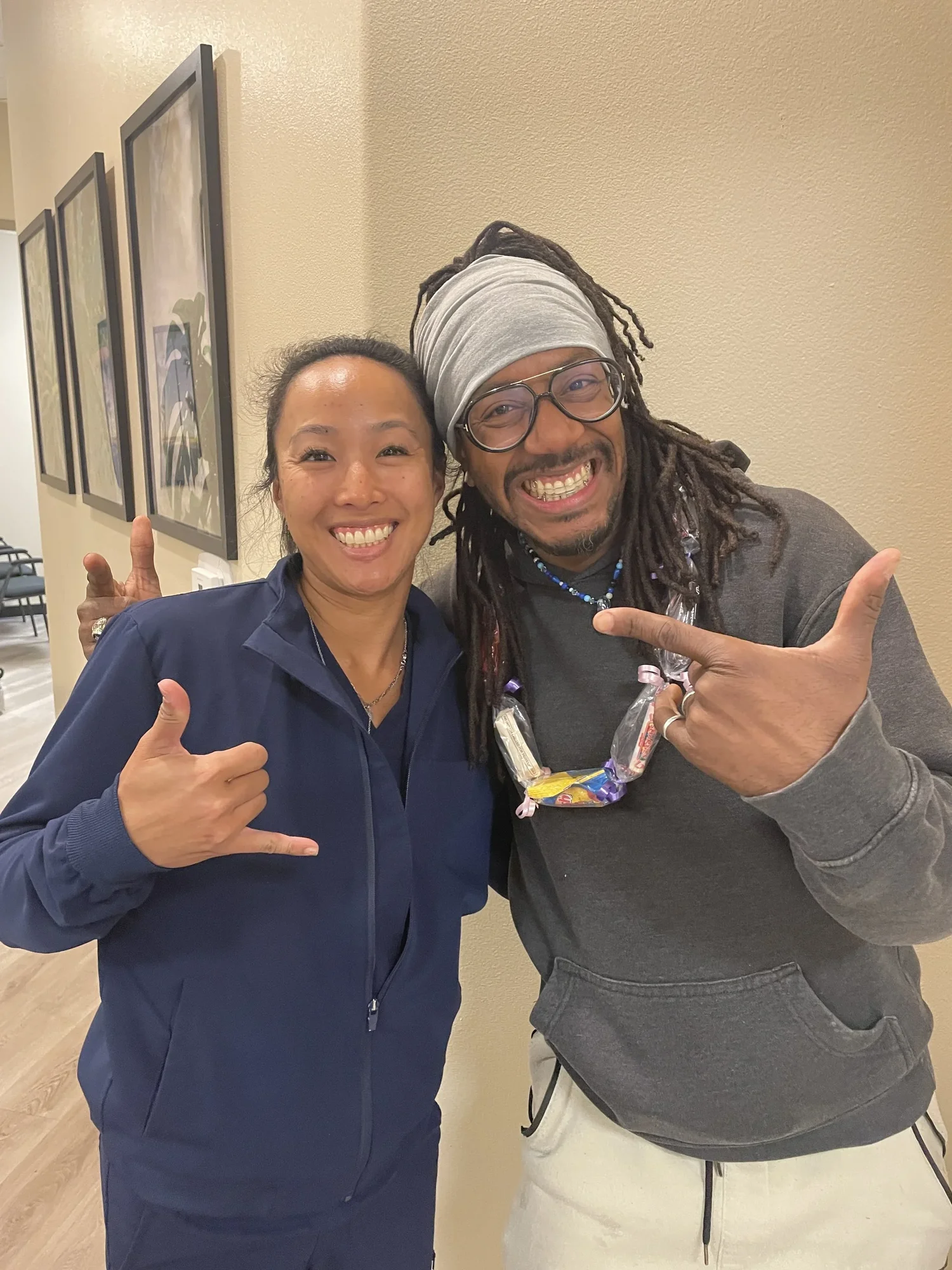
You will see Dr. Beth at every single visit
Beth’s Braces is a single practice, not a group with rotating providers. The person who plans your treatment is the person who adjusts it, start to finish.
Our assistants have been here the better part of a decade, so they know your case without pulling the chart. English, Tagalog and German are all spoken at the desk.
Related guides from Beth’s Braces
You have thought about it long enough.
A free hour with Dr. Beth, a 3D scan, and a written plan with real numbers. No pressure to decide that day, and nothing owed if you do not.