
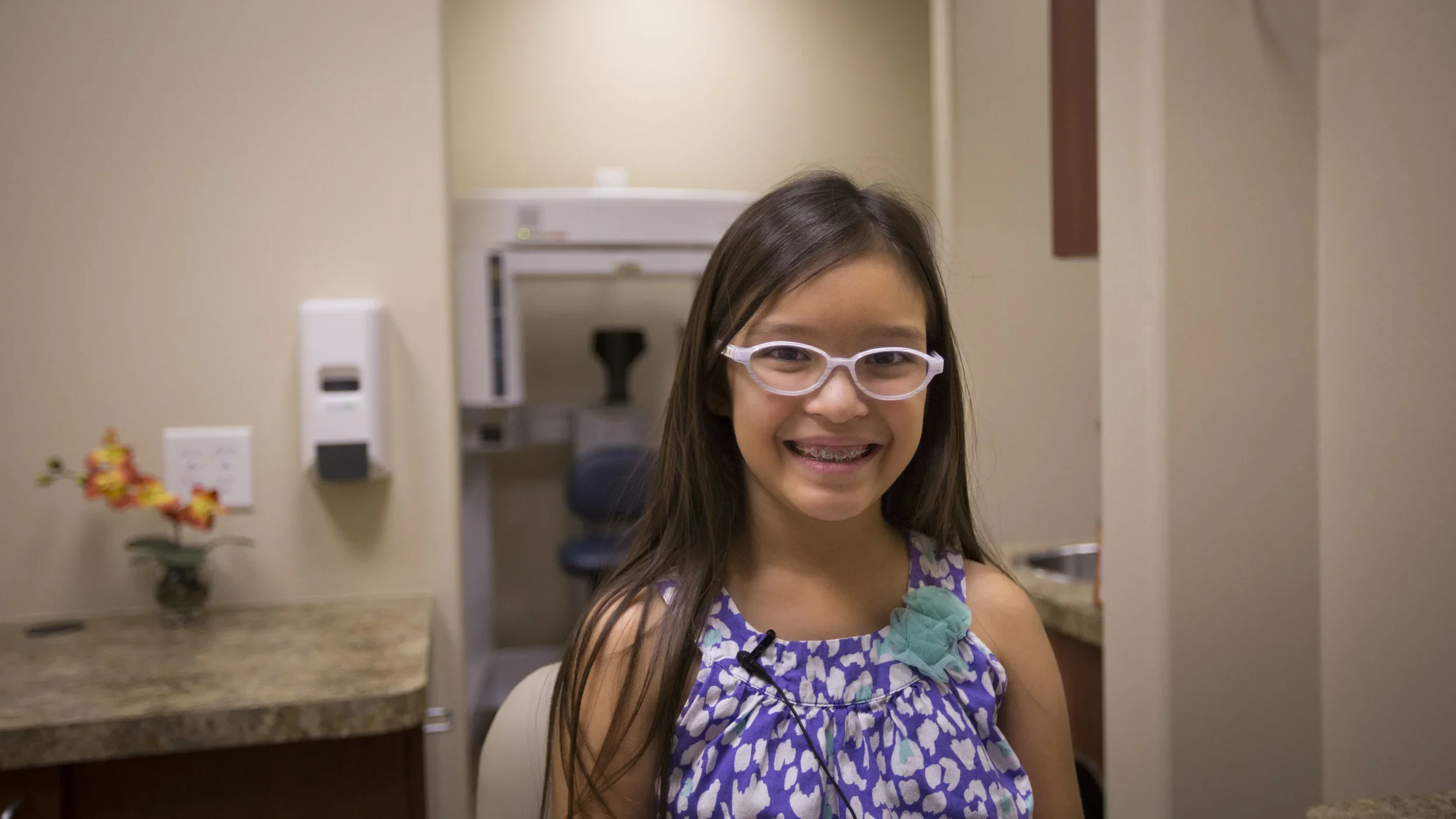
Braces for Kids in Las Vegas & Henderson
If your child genuinely needs braces, here is what the next eighteen months look like — and how to make them easier on everyone.

Does your child actually need braces yet?
Quite often the answer is no, or not yet, and we would rather say so than start something early to fill a chair.
There are two different conversations here and they get conflated constantly. Early or Phase 1 treatment is a short, targeted course for children roughly six to ten, addressing one specific developmental problem — a crossbite, an underbite, severe crowding — while the jaw is still growing. Most children do not need it. That is covered separately.
This page is about the other thing: comprehensive braces for a child whose permanent teeth have largely arrived and who genuinely needs the full arch treated. That typically starts between ages eight and twelve depending on how quickly their teeth come through, though many children are better served waiting until eleven or twelve.
At the free evaluation, Dr. Beth will tell you which conversation you are actually in. For a lot of families the answer is a check-in eighteen months from now.
Nothing about this should frighten them
Children arrive expecting something worse than what happens. Here is what you can tell them beforehand, accurately.
Photos, which is just a camera
A few pictures of their teeth and face. Nothing goes in their mouth beyond a small retractor to hold their lips back, which is odd-looking but not uncomfortable.
A 3D scan they get to watch
Our iCAT FLX scanner takes seconds, requires nothing in the mouth, and there is no big machine to sit inside. Most children find it genuinely interesting, and Dr. Beth turns the screen around so they can see their own teeth in 3D.
Dr. Beth looks and explains
She talks to your child, not over them. If she is going to recommend treatment she explains why in words an eight-year-old follows — and if she is not, she says that too.
Nothing is done that day
The first visit is a look and a conversation. Nobody bonds anything, and there are no needles at any point in orthodontic treatment. Worth telling them explicitly, since it is the thing they are usually worrying about.
Getting through the adjustment period
The hard part is short. Being ready for it makes it considerably shorter.
Days 1–3: soft food
Expect a dull ache, not sharp pain, starting a few hours after bonding. Stock up before the appointment: yoghurt, pasta, eggs, smoothies, mashed potato, soup. Cold things help. Children’s ibuprofen at the recommended dose covers it.
Wax is your friend
New brackets rub the inside of the cheek until the tissue toughens up, which takes about a week. Orthodontic wax pressed over the offending bracket solves it immediately. Send a small tin in their school bag.
Salt water rinses
Warm salt water a few times a day soothes irritated cheeks and speeds up the toughening. Cheap, effective, and something a child can do themselves, which helps them feel less passive about it.
Talking and eating feel odd
Both normalise within days. Children adapt considerably faster than adults do — by week two most have stopped mentioning the braces entirely.
A new brushing routine
Brush after every meal, angling above and below each bracket. Interdental brushes for the gaps between bracket and wire. Expect to supervise this for the first month at least.
What to send to school
Wax, a travel toothbrush, and a note that they may need a moment after lunch to brush. Most teachers are entirely fine about it once asked.
Why hygiene supervision is not optional
This is the single thing that determines whether your child finishes treatment with a good result or a compromised one, and it is the thing parents most often underestimate.
Brackets create dozens of new sheltered spots where plaque sits undisturbed. Where it sits long enough, it demineralises the enamel underneath and leaves a permanent chalky white square — visible for life, exactly outlining where the bracket was. Straight teeth with white scars on them is not the outcome anyone paid for.
Children are not deliberately careless about this. They are eleven, and brushing thoroughly around twenty brackets is genuinely harder than brushing normal teeth. So: check their work for the first month, then spot-check periodically. Keep their six-month dental cleanings, which matter more during treatment rather than less.
A water flosser is worth the money if your child resists threading floss. Compliance beats technique.
Braces for kids FAQ
What age can a child get braces?
Comprehensive braces typically begin between ages eight and twelve, once enough permanent teeth have arrived to treat the full arch. Many children are better served waiting until eleven or twelve. A first orthodontic evaluation is recommended by age seven, but that visit is diagnostic rather than the start of treatment.
How is this different from early or Phase 1 treatment?
Phase 1 is a short targeted course, usually ages six to ten, addressing one specific developmental issue like a crossbite while the jaw is still growing. Comprehensive braces treat the whole arch once the permanent teeth are in. Most children need only the latter, and only once.
Do braces hurt children more than adults?
No — if anything children adapt faster. Expect a dull ache for two or three days after placement and for a day after each adjustment. Children’s ibuprofen and soft food handle it. There are no needles at any point in orthodontic treatment, which is usually their actual worry.
How long will my child be in braces?
Eighteen to twenty-four months for most comprehensive cases, with simpler crowding finishing sooner. We provide a projected end date at the start, based on your child’s own 3D scan.
Can my child still eat normally?
Mostly, with exceptions. No ice, hard sweets, caramel, taffy, nuts, popcorn kernels or jerky. Apples, carrots and corn should be cut up rather than bitten into. Nearly every broken bracket we re-bond traces back to that list.
What if a bracket breaks at school?
Have them cover it with wax and call us. It is common and usually re-bonded in a short visit. Do not wait for the next scheduled appointment, since a loose bracket is not doing its job.
Will my child need braces again later?
Not if they wear their retainer. Teeth drift throughout life, and skipping retention is the single most common reason people end up back in treatment as adults. For children we often recommend a bonded retainer behind the lower front teeth, since it removes compliance from the equation.
Does insurance cover braces for children?
Frequently. Many dental plans carry a separate lifetime orthodontic benefit, and a good number apply it only to dependent children. We verify your specific plan before treatment starts and apply the benefit to your total. Nevada Medicaid is accepted.
Bring them in. We will tell you honestly if it is time.
A free evaluation with Dr. Beth, a gentle 3D scan, and a straight answer — including “not yet,” which is what plenty of families hear.