
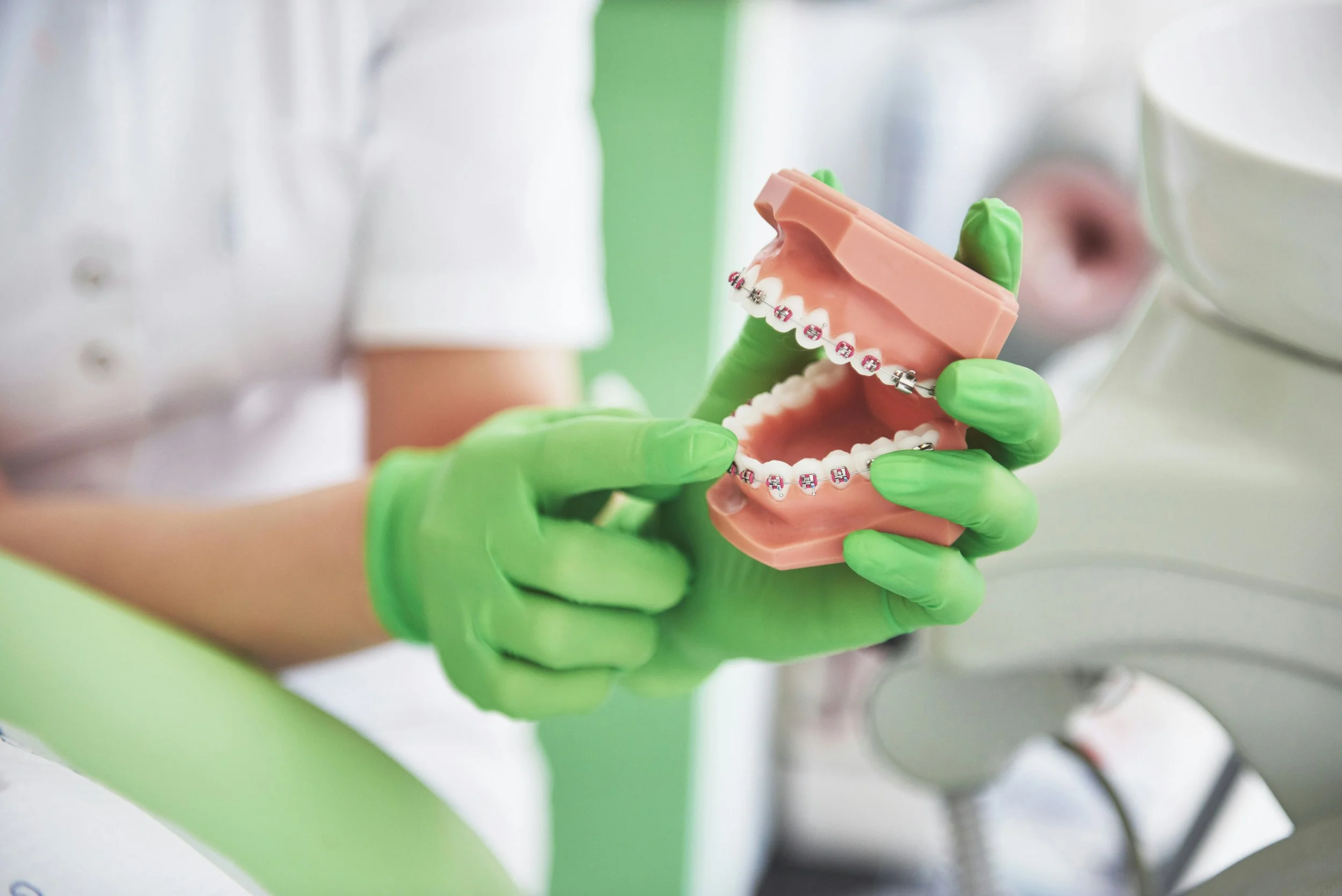
What Are We Actually Fixing?
Most people arrive knowing something is off without knowing what it is called. Start with what you have noticed, and we will tell you what it is.
Almost all of this is called malocclusion
Malocclusion simply means the teeth do not meet the way they ideally should. It is not a disease and it is extraordinarily common — some degree of it is closer to the norm than perfect occlusion is.
Which matters, because the useful question is never “do I have malocclusion.” It is whether yours is causing damage, is likely to, or bothers you enough to be worth eighteen months of treatment. Those are three different reasons and all three are legitimate.
Bite problems fall into two broad groups. Dental problems are about where the teeth sit — crowding, spacing, a rotated tooth. Skeletal problems are about how the jaws relate to each other, and those are the ones where age changes what is achievable, because guiding a growing jaw and repositioning a finished one are very different propositions.
A 3D scan tells us which you have in about ten minutes, and that answer drives everything else.
Bite problems
These are about the relationship between your upper and lower teeth — and several of them are commonly confused with each other.
Overbite
What you notice: the lower front teeth largely disappear behind the uppers when you bite together. In severe cases they contact the gum behind them.
A vertical problem. Some overlap is normal — the issue is excess, which orthodontists call a deep bite. It wears the front teeth and can damage the tissue behind the uppers.
Overbite treatment →Overjet
What you notice: the front teeth visibly stick out. Often called buck teeth.
A horizontal problem, and the one nearly everyone miscalls an overbite. It carries the clearest safety argument of any bite pattern, because protruding front teeth are substantially more likely to be broken in a fall or collision.
Overjet treatment →Underbite
What you notice: the lower teeth sit ahead of the uppers. In pronounced cases the profile is visibly affected.
The pattern where waiting costs the most. Guided at eight or nine while the upper jaw can still be encouraged forward, it is a very different job from the same discrepancy at nineteen.
Underbite treatment →Crossbite
What you notice: the jaw slides sideways to bite together, or some upper teeth sit inside the lower ones.
The sideways shift is the urgent part. A jaw habitually shifting during the growth years can develop asymmetrically, which is considerably harder to fix than the crossbite that caused it.
Crossbite treatment →Open bite
What you notice: a visible gap between the front teeth even when biting down, and difficulty biting into a sandwich.
Usually driven by an ongoing force — a thumb, a tongue, a resting posture. Which is why treating the teeth without treating the cause reliably fails.
Open bite treatment →Not sure which you have?
Entirely normal, and you do not need to work it out before booking. Overbite and overjet in particular are confused constantly, even by dentists in casual conversation.
Bring the thing you have noticed. Dr. Beth will scan, name it, and tell you whether it warrants treating.
Book a free consultation →Spacing and position problems
These are about room — too little, too much, or a tooth that never arrived.
Crowded teeth
What you notice: teeth overlapping, twisted, or pushed out of line. Floss that will not go between certain teeth.
The most common reason anyone books with us. It also progresses — lower front crowding worsens through adult life even in people who never had braces.
Crowding treatment →Gaps & spacing
What you notice: visible gaps, most often between the two upper front teeth.
Frequently the fastest cases we treat. The important part is diagnosing why the gap opened, since a frenum or a tongue habit will reopen it after closure if left alone.
Gaps & spacing →Impacted teeth
What you notice: a permanent tooth that has not arrived on schedule, or a baby tooth that will not come out.
Time-sensitive. An impacted canine can dissolve the root of the tooth next to it — painlessly and invisibly without imaging.
Impacted teeth →When each of these is best addressed
Not everything needs treating now, and not everything can wait. This is the honest ordering.
| Condition | Best window | Why |
|---|---|---|
| Underbite | Ages 7–10 | Upper jaw can still be encouraged forward; later may mean surgery |
| Crossbite | Before mid-teens | Palatal suture fuses; expansion becomes surgical afterwards |
| Impacted canine | Ages 8–11 to detect | Early detection preserves options; the tooth can fuse to bone |
| Overjet | Evaluate at 7 | Injury risk is present now; growth can be guided |
| Open bite | While habit is active | Stopping the habit early often corrects it with no braces at all |
| Overbite | Teens, or any age | Growth helps in skeletal cases; dental cases treat well later |
| Crowding | Once permanent teeth are in | Progressive, so earlier is easier — but rarely urgent |
| Gaps & spacing | Usually wait in children | Front gaps often close naturally when canines erupt |
This is the argument for an evaluation by age seven, not a sales pitch for treating seven-year-olds. Most children we see at that age need nothing, and we say so. The visit exists so that the four conditions at the top of that table are caught while the window is open — and so the rest can be watched rather than guessed at.
How we work out what you have
You tell us what you have noticed
You do not need the terminology. “My son’s jaw shifts when he bites” or “my bottom teeth have got crooked since my twenties” is more useful to us than a self-diagnosis.
3D imaging with the iCAT FLX
Teeth, roots, bone and soft tissue in three dimensions. This is what distinguishes a dental problem from a skeletal one, and it is the only reliable way to locate an impacted tooth or see whether it is contacting a neighbouring root.
Dr. Beth reviews it with you on screen
She names what she sees and shows you, rather than describing it. If two conditions are present — which is common, since crowding and crossbite often travel together — she explains how they interact.
A recommendation, including “not yet”
Whether treatment is warranted, when, what it would involve and what it would cost, in writing. Monitoring is a legitimate outcome and the most common one for young children.
About bite problems generally
What is malocclusion?
It means the teeth do not meet the way they ideally should. It is not a disease and some degree of it is closer to the norm than perfect occlusion is. The useful question is not whether you have malocclusion but whether yours is causing damage, likely to, or bothering you enough to treat.
What is the difference between a dental and a skeletal problem?
A dental problem is about where the teeth sit within the jaws — crowding, spacing, a rotated tooth. A skeletal problem is about how the jaws relate to each other. The distinction matters enormously for timing, because a growing jaw can be guided while a finished one can only be repositioned surgically. A 3D scan establishes which you have.
Can I have more than one of these at once?
Very commonly, and they often travel together. Crowding and crossbite frequently appear in the same patient because both relate to a narrow upper arch. Overbite and overjet regularly coexist. Treatment is planned around the whole picture rather than one condition at a time.
Do all of these need treating?
No. A mild overbite causing no wear, or a diastema you happen to like, can reasonably be left alone. Where treatment is genuinely warranted is when there is damage occurring, damage likely to occur, or a functional problem. Wanting it treated for appearance is also a legitimate reason, and we will not pretend otherwise.
Which of these are urgent?
Underbite, crossbite and a suspected impacted canine are the three where waiting genuinely costs options, because each depends on a growth window that closes. An overjet in a child who plays sport is urgent for a different reason — injury risk that exists now.
Will my child grow out of any of this?
Some things yes, some no. Front gaps in children commonly close on their own when the canines erupt. Open bites often correct if a thumb habit stops early enough. Underbites and crossbites do not self-correct and typically worsen. That distinction is exactly what an evaluation at seven is for.
Can these problems cause jaw pain or TMJ issues?
Sometimes, and we would rather not overstate it. Certain bite patterns load the jaw joints unevenly and some patients experience discomfort as a result. However jaw pain has several possible causes and the relationship with bite is more complicated than commonly claimed. Dr. Beth will give you a straight assessment rather than a promise.
Is treatment purely cosmetic?
It depends on the condition. Crowding has a genuine hygiene argument, overjet has a clear injury argument, crossbite has a growth argument, and impacted teeth have a real risk argument. Some cases are largely cosmetic, and where that is true we say so rather than dressing it up as a health necessity.
You do not need to know the name for it.
Bring what you have noticed. A free hour, a 3D scan, and a straight answer about what it is and whether it needs anything doing — including when the answer is no.